
Motherhood is an adventure, one that comes with its share of important decisions. And the moment a medication becomes part of the equation, those decisions take on a different weight: they can affect two lives.
That’s why, whenever a drug is being considered or prescribed, it is essential to make informed choices that reflect the clinical context and protect the health of both mother and baby. This vigilance matters even more because unplanned pregnancies remain relatively common, according to the Canadian Network forMood and Anxiety Treatments (CANMAT). For that reason, it is helpful to anticipate certain situations and, whenever possible, choose safer options for people ofchildbearing potential.
A widely respected international reference, Briggs, Drugs in Pregnancy andLactation: A Reference Guide to Fetal and Neonatal Risk, offers recommendations to help healthcare professionals assess the level of risk associated with a specific medication when used at usual doses for typical indications.
In practice, however, assessing safety requires a broader analysis, since several factors can significantly influence risk, such as genetics, lifestyle habits, or polypharmacy. As a result, recommendations may not apply to every patient, and clinical judgment remains essential.
In this article,I walk through the key points to keep in mind when weighing medication safety in pregnancy, with the goal of supporting decisions that truly fit the person in front of us.
Key Factors When EvaluatingMedication Safety During Pregnancy
Medication-Related Risks GuideTreatment Choices
Randomized, double-blind clinical trials rarely assess medication risks during pregnancy. Most available evidence comes from observational studies. These data need to be interpreted carefully when evaluating risk for both the fetus and the pregnant person. Observational studies cannot establish cause and effect, and residual confounding may persist. Over-the-counter medication use, smoking, and a history of preterm delivery are all examples of factors that can influence outcomes. When the group that is exposed to a medication and the control group differ in meaningful ways, results can be skewed.
It is also important to remember that relative risk (RR), defined as the probability of an outcome in one group compared with another, depends on the baseline risk of that outcome. For example, the prevalence of congenital heart defects in Canada is roughly 20 per 10,000 births (source: InfoBase), while the prevalence of miscarriage before 20 weeks is approximately 15 to 25 percent (source: Public Health Agency of Canada). In the general population, fewer than 5 percent of major congenital malformations are linked to medication-related causes, according to the Centre de Référence sur les Agents Tératogènes (CRAT – In French only). In other words, there is no such thing as zero risk, even without medication exposure.
Chronology is One of the Most Critical Pieces of the Puzzle
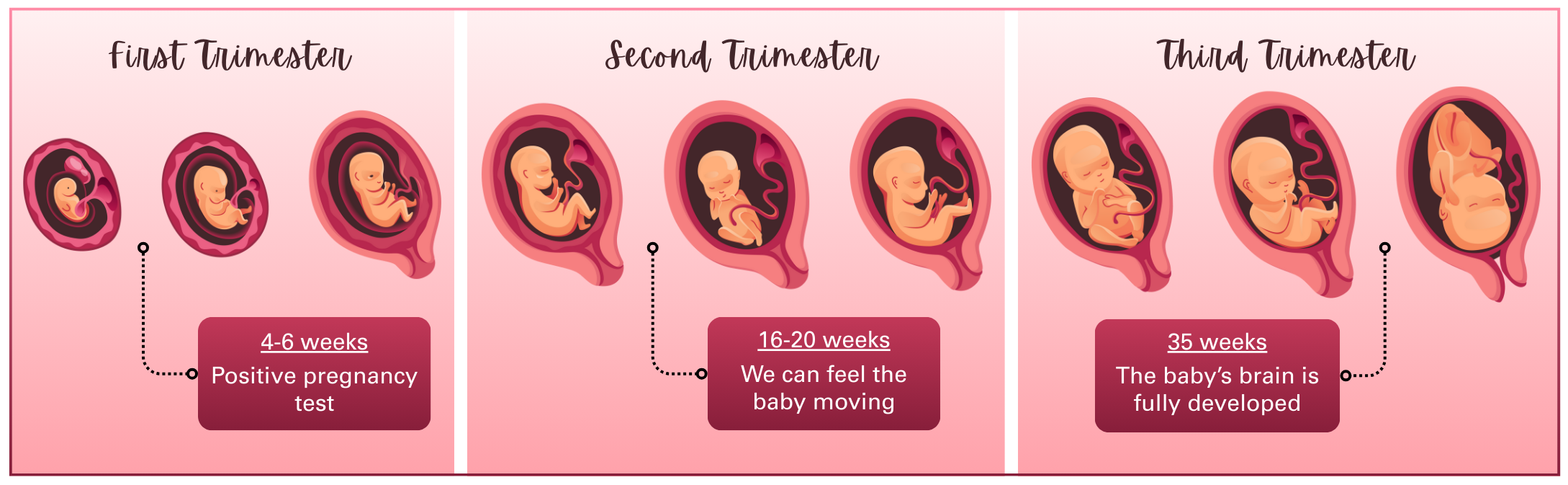
Chronology is one of the most important factors to consider when assessing potential risk. By the time a pregnancy test comes back positive (see figure 1), the fetus may already have been exposed to a medication for days, and sometimes even weeks.
Also, the same medication can produce different effects and risks depending on the trimester and developmental stage. For example, taking an anti-inflammatory during the third week of pregnancy (figure1) may lead to an “all-or-nothing” effect. The pregnancy either continues normally or ends. Without knowing they are pregnant, a person may inadvertently expose the embryo to a medication. In the third trimester (figure 1), the main concern is no longer miscarriage or congenital malformation. At that stage, however, anti-inflammatories may affect fetal circulation or amniotic fluid.
Figure 1 − Embryonic development (image customized by Vigilance Santé)
Past and Current Response to Treatment Matters, Including to Non-Pharmacological Options
A lack of response to a medication or to a non-pharmacological treatment in the past may justify avoiding certain options, even when they are considered safe. Conversely, a meaningful clinical response in someone with persistent or treatment-resistant illness may support the use of certain medications despite known risks.
Comorbidities and Medical History
Comorbidities and medical history can have an effect on the risk of pregnancy-related complications. For example, a person with a clotting disorder has a higher risk of hemorrhage during delivery (source: Bleeding disorders and postpartum hemorrhage by mode of delivery: a retrospective cohort study).
According to CANMAT guidance, risks associated with polypharmacy are considered slightly higher than those associated with monotherapy. In the perinatal period, for conditions related to mood disorders, anxiety, or associated conditions, the guide encourages clinicians to consider optimizing a single medication, or using non-pharmacological interventions, when possible, before prescribing a combination of medications.
Reminder: every medication prescribed during pregnancy should have its indication confirmed, and its usefulness reassessed all the way through to delivery.
Side Effects and Drug Interactions
Each medication has its own adverse-effect profile, and that profile can shape treatment decisions during pregnancy. Potential drug interactions should also be assessed.
Transfer Into Breast Milk
When choosing a medication during pregnancy, it is important to consider whether it passes into breast milk, even if the person does not plan to breastfeed. Even if breastfeeding is not part of the plan right now, that plan can shift once the baby is here.
Evaluating the Risk of Not Treating and Illness or a Symptom
Medication risks are often documented in reference texts. However, there are also risks to leaving a condition or symptom untreated. For example, untreated fever during pregnancy may lead to complications and consequences for the newborn (source: Naître et grandir).
Stopping along-term treatment abruptly, or reducing a dose solely to minimize fetal risk,can also be a mistake. It may lead to a relapse or worsening of the condition,with consequences that can be serious for the mother, the baby, or both. Alltreatment options, pharmacological and non-pharmacological, should be evaluatedfor both safety and effectiveness, then compared within the clinical context.
RxVigilance: A Major Update to Pregnancy and Breastfeeding Content
Vigilance Santé’s priority is to provide care teams with reliable, contextualized, and up-to-date clinical information, while simplifying access to essential reference points at the time of care.
With this goal in mind, our team completed a major update in 2025 to the Pregnancy and Breastfeeding content in RxVigilance. This update was made possible in part through an agreement with the publisher of Brigg's Drugs in Pregnancy and Lactation: A Reference Guide to Fetal and Neonatal Risk, and it further strengthens RxVigilance’s clinical value.
It is also designed to support healthcare professionals caring for a patient population whose needs are both unique and complex.
RxVigilance users will find the enhanced content, in both English and French, in the February 2026 release. We invite you to explore it and, above all, to use it to support your practice.
Watch the short video at the end of the article for a quick preview!
Pregnancy and Breastfeeding: Shared Decision-Making at the Heart of the Solution
It is essential to discuss the risks and benefits of each treatment option with our patients, and when possible, to include loved ones in that conversation (INESSS).
No decision should be rushed. Scientific information found in monographs can support decision-making, but it is only one part of the picture. Every relevant factor needs to be considered.
As a final thought, perinatal care reminds us that decisions are rarely straightforward. Taking the time to weigh options together, with nuance, is one of the best ways to protect both mother and baby.
We hope this article has given you useful insights you can apply moving forward!

DISCLAIMER
This blog is intended for information purposes only. The views and opinions expressed are solely those of the original authors and contributors, and do not necessarily reflect, in whole or in part, those of Vigilance Santé. Vigilance Santé makes no warranty as to the accuracy, comprehensiveness or correctness of the information contained in this blog. The information presented in this blog is in no way a substitute for professional medical advice, diagnosis, or treatment, or for the skills and expertise of a health professional. Neither Vigilance Santé (nor its shareholders, officers, directors, executives, employees, collaborators, subcontractors, and distributors) nor the authors may under any circumstances be held liable for any loss or damage directly or indirectly related to the content of this blog or its use.


